24/7 Emergency Service | Licensed & Insured | Upfront Pricing.
 Call Now: (305) 507-45-57
24/7 Emergency Service | Licensed & Insured | Upfront Pricing.
Call Now: (305) 507-45-57


When a home starts smelling like a swamp, it's more than just an annoyance. After 15 years of troubleshooting plumbing from Hialeah to Brickell, our team knows one thing for sure: that smell is a diagnostic tool. Your Drain-Waste-Vent (DWV) system—the network that carries waste out and lets air in—is trying to tell you that a barrier has failed.
Before calling for a service visit, follow this sequence to rule out the simple fixes.
1. Locate the source: is the smell coming from one specific sink, or is it everywhere?
2. The "Water Seal" Check: go to every drain—especially guest baths or laundry floors. Run the water for 60 seconds.
3. The "Wobble" Test: gently try to move your toilets. If one shifts, the seal is broken.
4. Wait 24 hours: if the smell vanishes, you've fixed a dry trap. If it persists, the problem is structural.
Sewer gas is a "cocktail" of vapors created by decomposing waste. It's not just one thing, and some components are more aggressive than others.
What's actually in the air:
Safety Note: Beyond immediate sewer issues, if you have a tight crawlspace or basement, be aware of Radon. While odorless and unrelated to sewer gas, it's linked to a 16% increase in lung cancer risk for every 100 Bq/m³ increase in concentration [8]. If you're investigating air quality, it's worth a separate test.
In a perfect world, sewer gases stay in the pipes and vent out through your roof. When they end up in your kitchen, it's usually because one of your "traps" or "seals" has failed. Your nose is incredibly sensitive to Hydrogen Sulfide—you can pick it up at just 0.13 ppm [3]. Even if it's faint, don't ignore it; chronic exposure to levels under 10 ppm can leave you feeling dizzy and nauseous [3].
The P-trap is the U-shaped pipe under every sink. It's designed to hold a "water seal" that acts as a physical wall, blocking gas from coming up the drain.
How it fails: if you don't use a sink or floor drain for a few weeks (especially in our Miami heat), that water evaporates. The "wall" disappears, and the sewer has a direct vent into your room.
The Fix: run the water for a minute. You need a water seal of at least 60 mm (about 2.4 inches) to keep the gases out [4].
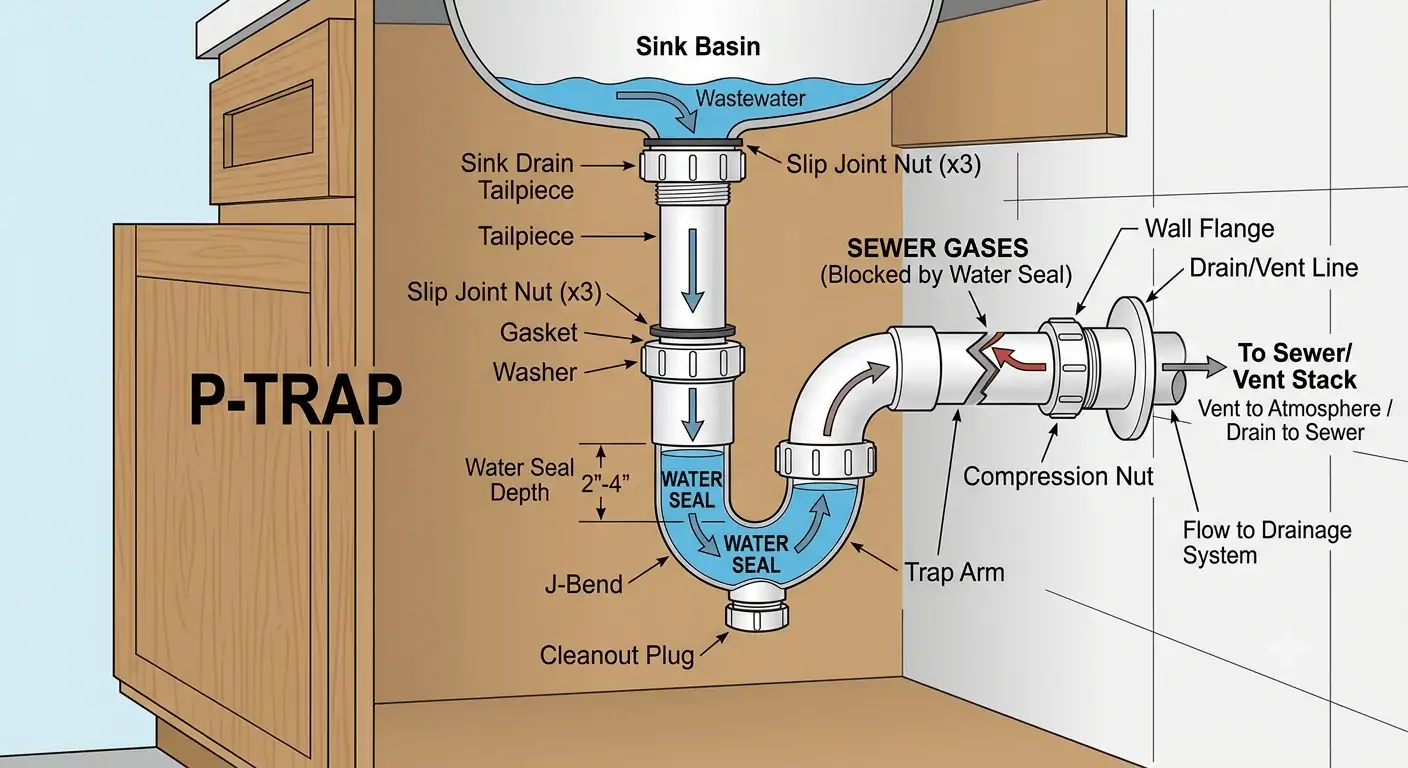
How does P Trap work?
If the water trick didn't work, we are looking at a physical failure.
1. The Wobbly Toilet (Failed Wax Ring): if your toilet moves even a tiny bit, the wax seal underneath is likely broken. It might not leak water yet, but it's definitely leaking gas.
2. Roof Vent Blockage: your plumbing needs to "breathe." If the vent on your roof is clogged by a bird's nest or debris, it creates a vacuum that sucks the water out of your P-traps every time you flush.
3. The "Gunk" Factor (Biofilm): sometimes it's not the sewer—it's just a colony of bacteria living on hair and soap scum.
4. Old Cast Iron Pinhole Leaks: if your home was built before the 1970s, your cast iron pipes might have tiny leaks along the top where the gas sits.
5. Dishwasher Setup: if your dishwasher drain hose doesn't have a "high loop" (a curve that stays above the drain level), old food can sit in the line and rot, smelling exactly like a sewer backup [6].
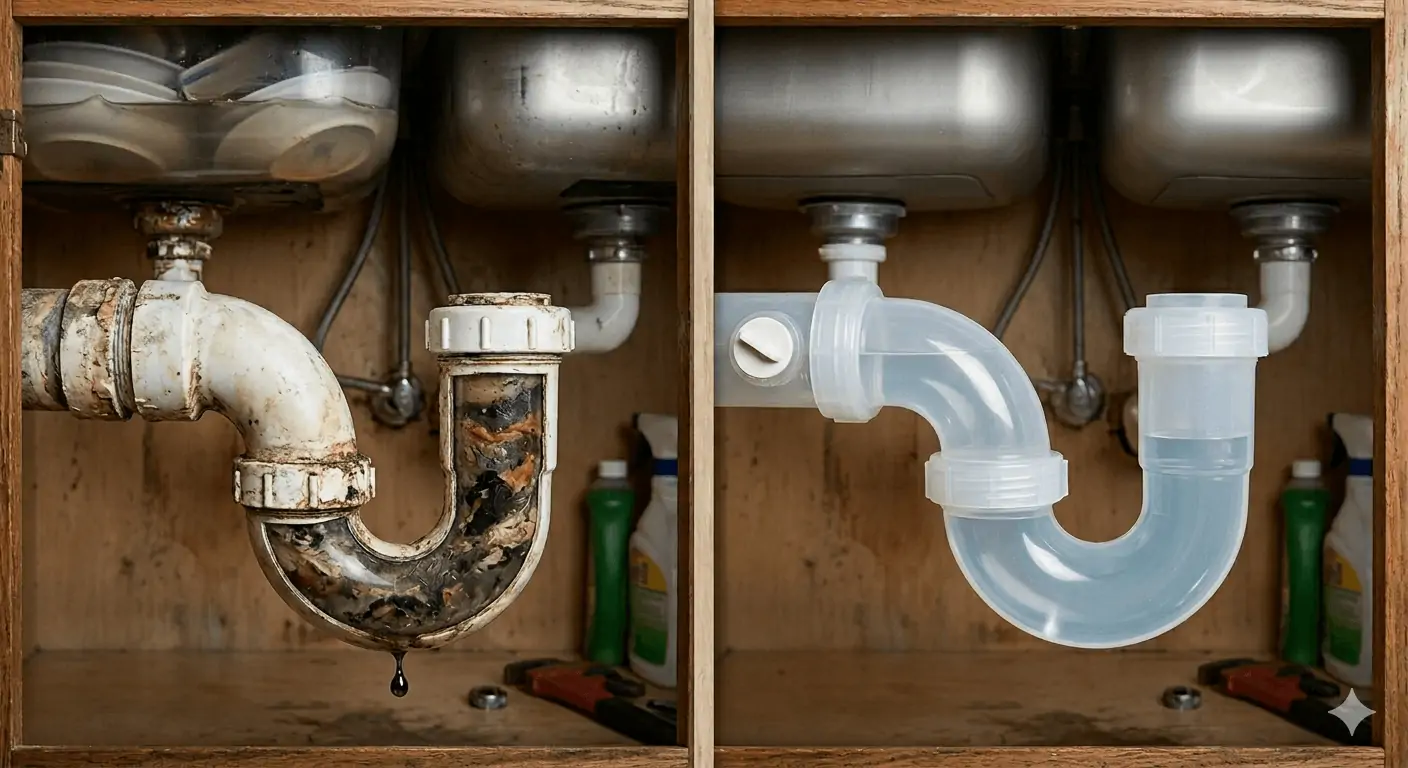
Not every smell is a broken pipe. Sometimes, it's just years of "biofilm" (hair and soap) that needs a deep clean.
When the source isn't obvious, we use tools that remove the guesswork:
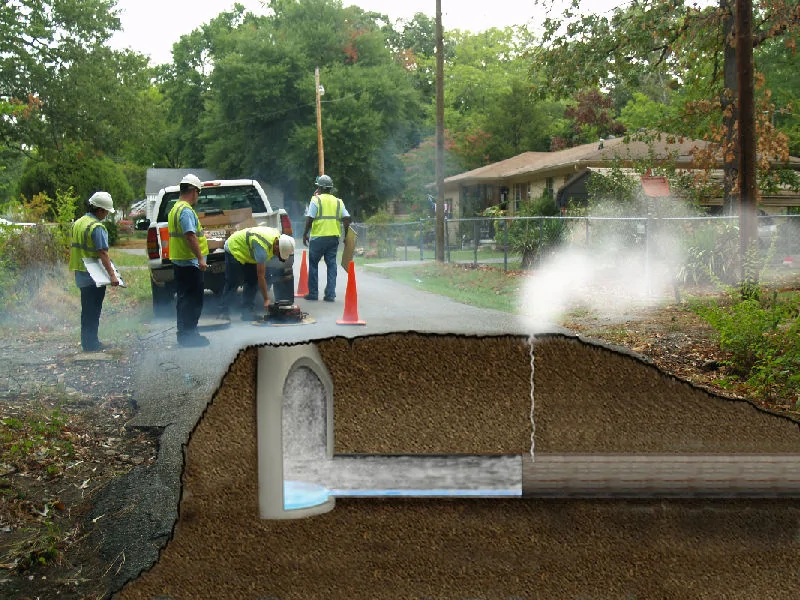
A smoke test reveals a hidden crack behind a bathroom wall—no guesswork required.
| Task | Safe for DIY? | The Risk |
|---|---|---|
| Filling P-traps | Yes | None |
| Cleaning Biofilm | Yes | Minimal |
| Replacing a Wax Ring | Maybe | High risk of floor-ruining leaks if misaligned |
| Clearing a Roof Vent | No | Serious fall hazard |
| Hydro-jetting lines | No | Can destroy old pipes with excessive pressure |
A warning from the field: avoid pouring heavy sulfuric acid down your drains. It's brutal on pipes and can eat through your seals, turning a smelly drain into a flooded house [5].
1. Use Enzymes, Not Acid: monthly enzymatic cleaners eat the "gunk" (biofilm) without damaging your plumbing.
2. Check Your Roof: ensure your vent stacks aren't covered by leaves, especially after a storm.
3. Clean Your Appliances: clean your dishwasher filter every few weeks. It's the primary cause of "mystery" kitchen smells [6].
Yes. High levels of methane displace oxygen. Hydrogen sulfide is even more dangerous—at 700-1000 ppm, it can cause immediate collapse [1], [3]. If the smell is overpowering, evacuate.
For a smelly sink drain, yes. Pour 1/2 cup of baking soda, then 1 cup of vinegar. Let it fizz for 10 minutes before flushing with hot water [7]. This kills the "gunk" smell but won't fix a broken pipe.
Check the "standpipe" (the pipe the hose goes into). If there's no P-trap there, or if the hose is shoved too far down, you're breathing in the municipal sewer.
We understand that a mystery smell can make you feel like your home is working against you. But remember: most of the time, your plumbing is just asking for a little bit of water or a new seal. Take it step-by-step. Start with the drains, check the toilets, and if the air doesn't clear, don't wait for the headache to start. You've got the knowledge to handle the basics—and we're here if the problem goes deeper than the sink. You don't have to live with a swamp in your living room.
[1] OSHA Safety Manual (H2S) - IDLH and Exposure Limits — https://www.osha.gov/sites/default/files/publications/OSHA4204.pdf
[2] BP Contractor Policy - H2S Evacuation Protocols — https://www.bp.com/content/dam/bp/country-sites/en_us/united-states/home/documents/products-and-services/pipelines/contractor-information/policy/hydrogen-sulfide-policy.pdf
[3] ATSDR Toxicological Profile for Hydrogen Sulfide — https://www.atsdr.cdc.gov/toxprofiles/tp114-c1-b.pdf
[4] MasterProf Academy - Siphon Standards and Water Seals — https://masterprof.net/academy/articles/sifon-vidy-kak-sobrat-kakoy-vybrat/
[5] Hemkor - Chemical Cleaning and Pipe Corrosion — https://hemkor.ru/blog/stati/prochistka-kanalizatsionnyh-trub
[6] Consolidated Maintenance Schedule (Dossier Data)
[7] Purdue Extension - Baking Soda and Vinegar Reaction — https://extension.purdue.edu/4-H/_docs/get-involved/discovery-programs/discovery_media/5thbakingsoda1.pdf
[8] WHO - Radon and Health Risks — https://www.who.int/ru/news-room/fact-sheets/detail/radon-and-health
[9] EngineeringDom / Santehnik-Center - Service Price Lists — https://engineeringdom.ru/price/

 Verified by Carlos Rivera