24/7 Emergency Service | Licensed & Insured | Upfront Pricing.
 Call Now: (305) 507-45-57
24/7 Emergency Service | Licensed & Insured | Upfront Pricing.
Call Now: (305) 507-45-57


When the hot water cuts out mid-shower, you don't care about "thermodynamics"—you care about how fast you can get that heat back without draining your savings account. After 15 years of servicing homes across Miami, our team has seen every possible mistake a homeowner can make when choosing between gas and electric. The choice you make today stays with you for the next decade.
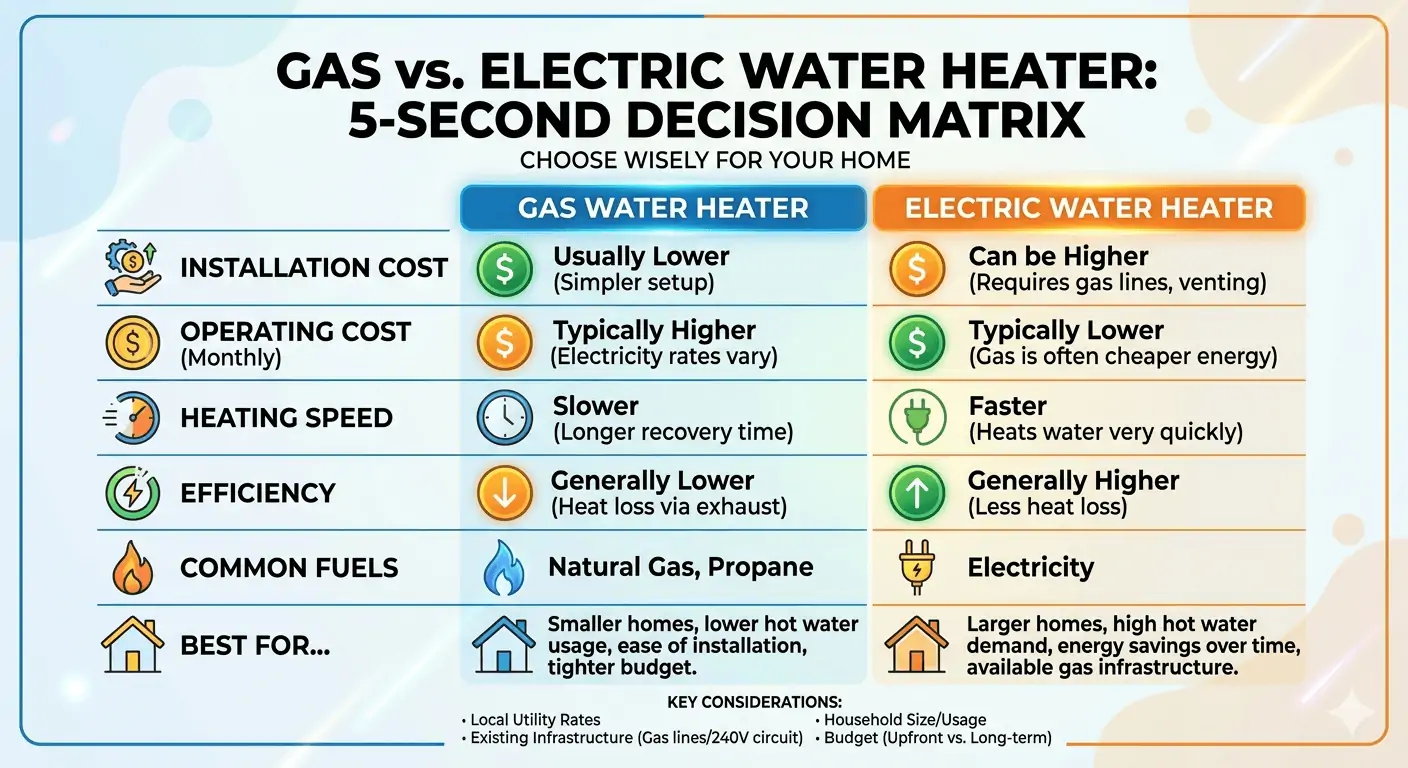
If you need an answer before the next load of laundry, here is the job-site reality:
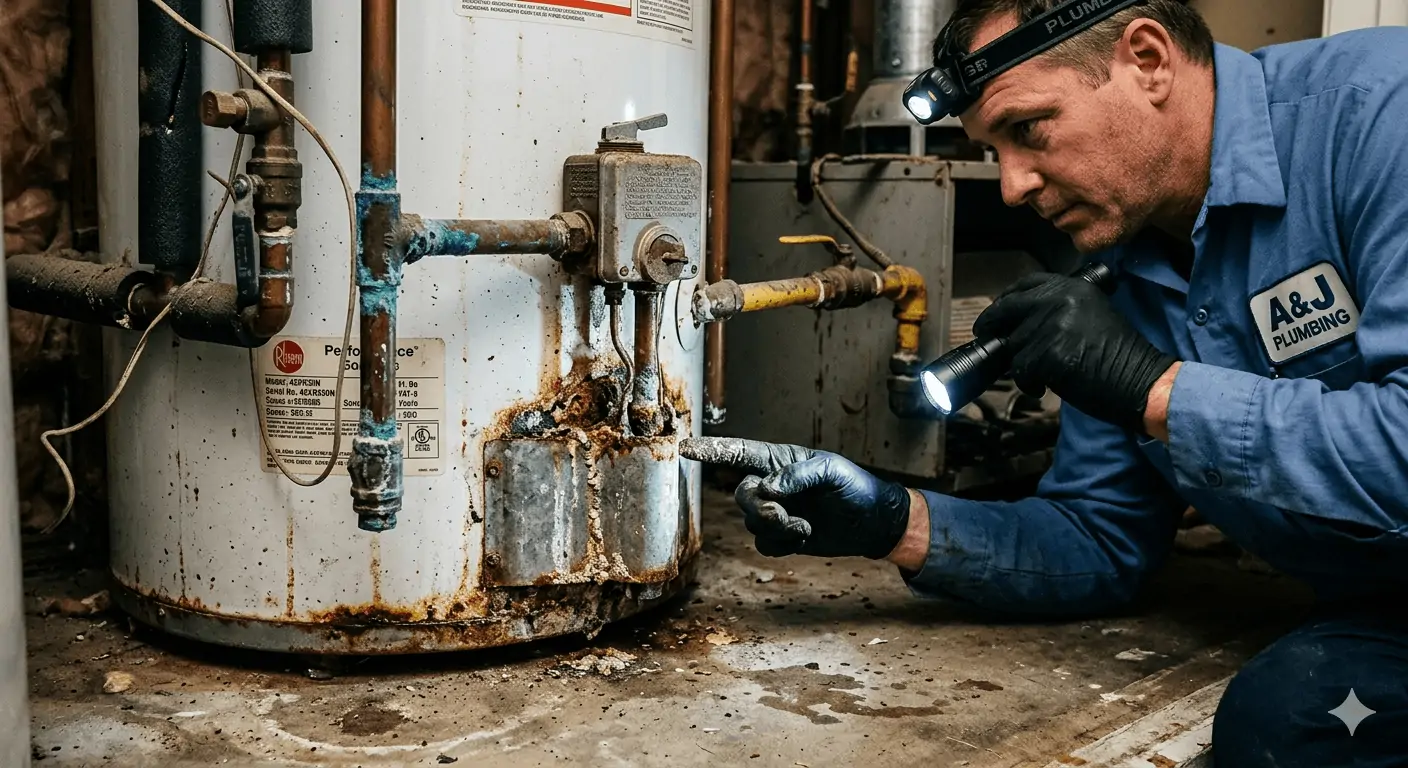
Water heaters rarely die quietly. They give warnings, but if you miss them, you end up with a flooded garage and a massive emergency bill. Most conventional tanks have a "best before" date: gas units usually last 10-15 years, while high-quality electric models serve for about 9-12 years [1], [2]. If you have a budget model, you might only get 5-7 years before the tank fails.
How to tell if your tank is waving the white flag:
In the plumbing world, we talk about "recovery rate." This is simply how fast the heater can provide another round of hot water after the tank has been emptied [7].
You will see a "Uniform Energy Factor" (UEF)—which measures how much energy actually turns into heat—on every unit. High-end hybrids, like the Rheem ProTerra, have a massive UEF of 4.07 [4]. That sounds amazing compared to a gas unit's 0.70. However, in most regions, electricity costs 2 to 3 times more than gas per unit of energy [5]. A "less efficient" gas heater is often cheaper to run every month.
Your tank is basically a giant thermos. If the insulation is thin, heat escapes while you sleep. Modern high-efficiency tanks use about an inch (25 mm) of polyurethane foam to lock that heat in [6].
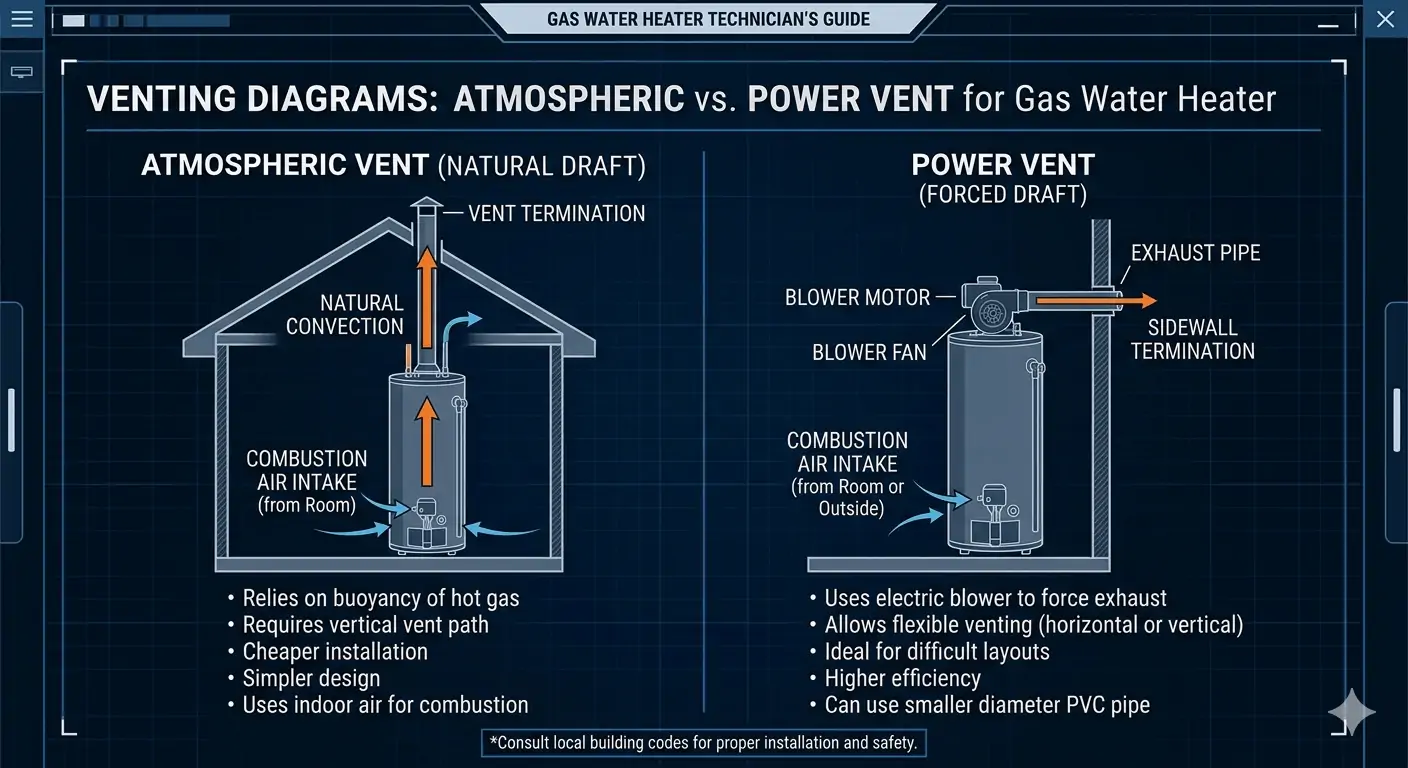
You cannot stick a gas heater in a tight closet without a plan. It needs a vent to prevent carbon monoxide buildup.
1. Atmospheric vent: a vertical chimney through the roof.
2. Power vent: a fan that pushes exhaust out a side wall.
3. Gas lines: your home needs enough "muscle" (BTUs—British Thermal Units) in the gas line to feed the burner [7], [9].
Electric heaters are "plug and play" only if your electrical panel can handle the load. They usually require a dedicated 240-volt circuit with a 22A to 50A breaker [8]. If your panel is full, adding an electric heater could cost an extra $1,500 to $3,000 in electrical upgrades [3].
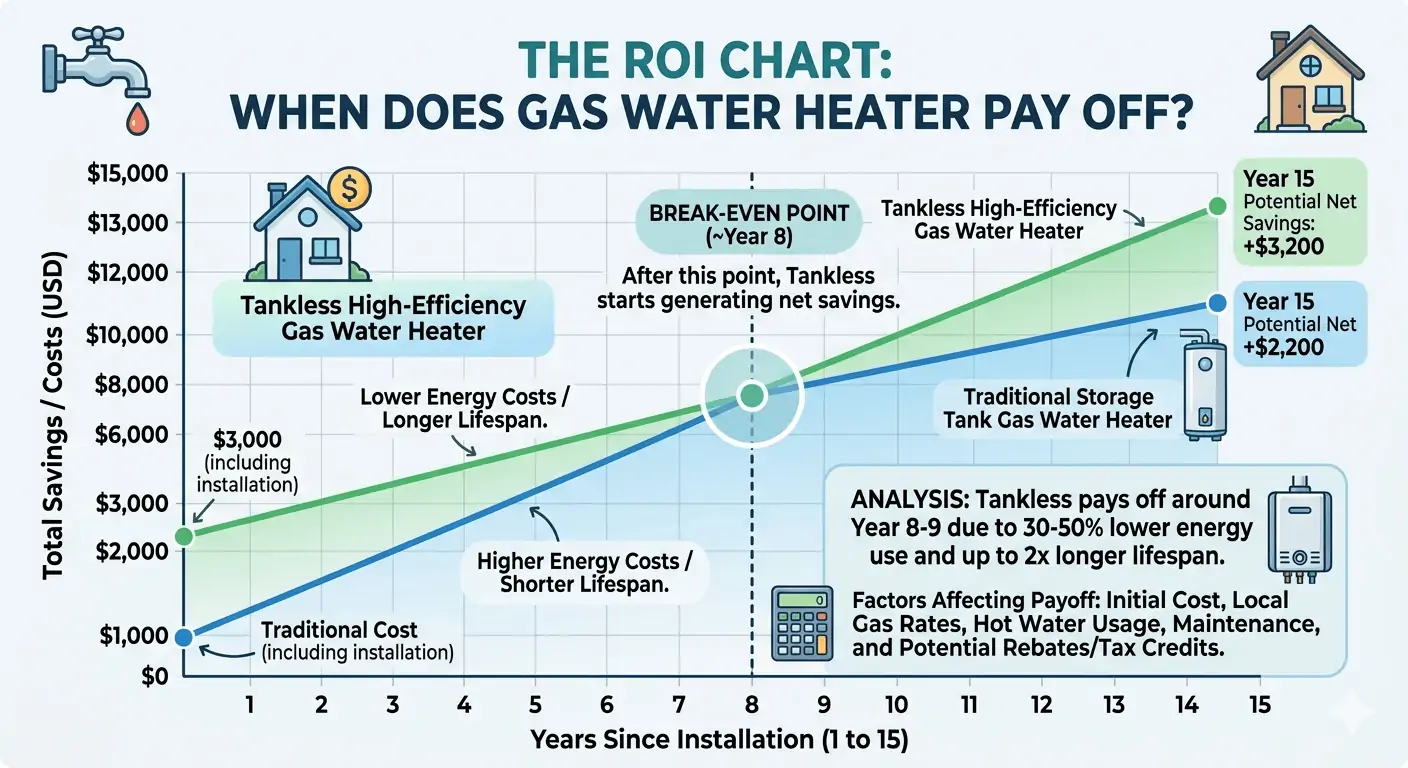
We're all for saving money, but some things carry a "stupid tax" that costs thousands.
You wouldn't drive a car for a decade without an oil change. Treat your heater the same way:
1. Flush the tank: do this once a year to remove sediment (mineral buildup) [11].
2. The anode rod: this is a "sacrificial" rod that rusts so your tank doesn't. Check it every 2 years. Replacing a $30 rod can save a $1,500 tank [11].
3. Temperature: keep it at 131-140°F (55-60°C). Any hotter and you get rapid scale buildup; any cooler and you risk *Legionella* (harmful bacteria) [12].
1. Measure twice: check the height and width. New high-efficiency units are often "fatter" due to thicker insulation.
2. Check the panel: open your breaker box. Do you have two empty slots for a 240V circuit?
3. Ask about the old tank: ensure your quote includes the removal and disposal of the old, heavy, rusty unit.
We know that staring at a leaking tank in the dark is stressful. But remember, a water heater is just a machine, and every plumbing problem has a solution. Whether you choose the raw power of gas or the simple reliability of electric, the goal is the same: keeping your home dry and your showers hot. Take a breath, check your breaker box, and make the call that's right for your family. You've got this, and if you don't—we're here to help.
[4] Rheem ProTerra Hybrid Specifications & UEF — http://rheem.com
[10] AO Smith ProLine Professional Advantage — http://hotwater.com
[11] Anode Rod Maintenance Protocols — http://masterprof.net
[13] Heat Pump Efficiency in Cold Climates — [Source: DOE EnergyStar Guidelines]

 Verified by Carlos Rivera